

The knee recovery program
The ideal list consists of bodyweight or light resistance exercises that put just enough strain on the knee to re-condition the muscles, without causing further damage to the joint. You'll also want exercises that work your knee in a few directions so they can target all supporting muscle groups, from the vastus lateralis in the quads to the biceps femoris in the hamstrings.
The best knee recovery exercises
Banded Side Shuffle
- Mind your form. Bend slightly at the hips and knees. From this position, step or ‘shuffle sideways. Move first to one side and then the other. Your pelvis should not move throughout the exercise, and you shouldn’t feel any tension in your lower back. If you do, adjust your form.
- Don’t let your ankles meet. You need to keep tension in the resistance band throughout the exercise. The band should not feel loose around your legs at any point. You can take smaller quick steps or slower wide steps as long as the band stays tense.
- For an easy shuffle, place the band up near your knees. For a hard shuffle, place it around your ankles.
Stability Ball Wall Slides
- Position the stability ball behind you, compressing it between your back and the wall. Since this ball is quite big, it will likely reach your upper and lower back.
- Place your hands on your quads or cross them over your chest.
- Gently press into the ball, ensuring your weight is supported and the position feels stable.
- Put your feet shoulder-width apart and around 20 cm in front of your body.
- Lower your hips and bend your knees until your thighs are parallel to the ground. For an easier squat, you can just go down to a depth you feel comfortable with. Keep your feet flat on the ground throughout the movement. Most of your weight should be pressed into your heels. Ensure your knees never move past your toes.
- Hold this position for 5 seconds. Exhale and push up to return to your start position.
- Repeat for 8-12 reps.
Clock Lunges
- Stand upright with your feet spread hip-width apart. Perform this exercise by completing all repetitions on one leg before switching to the opposite leg.
- Start with the left leg. Step forward to the 10 o’clock position, then step back to the starting position. Alternately, step back to 9 o’clock, then 8 o’clock.
- For the right leg, follow this same pattern, stepping to 2 o’clock, 3 o’clock and 4 o’clock positions.
Mini Squats
- Stand with your feet around shoulder-width apart.
- Hinge your hips back while slightly bending your knees, as if you are about to sit down. You can also raise your arms in front of you for balance.
- Lower yourself until your thighs are parallel to the ground or slightly above.
- Hold the squat for a couple of seconds and squeeze your glutes and thighs.
- Push through your feet to return to the starting position.
- Complete 3 sets of 8-12 reps, or as your ability allows.
- You should feel your thighs and hips working as you do this exercise.
Single Leg Mini Squat
- Stand on a flat surface with a neutral spine and your feet hip-width apart.
- Activate your core and plant the foot of your right leg firmly on the floor. During your squat, pressure should be evenly distributed between the heel and the left and right sides of the ball of your foot.
- For mini squats, slightly bend your left leg behind you. If you want to squat deeper, you can extend your left leg in front of you.
- Slowly squat down by bending your knee and hinging at the hip. Depending on how deep you want to go, you can keep your arms at your sides or hold them in front of you for balance. If you feel too unsteady, do the squats near a wall.
- On your way up, squeeze your glutes and push through the entire foot instead of just the ball or the heel.
- Repeat 10 times for 3 sets per leg.
Step Down Then Back
- Stand on an exercise step or box measuring approximately 15cm tall.
- Shift your weight onto your support leg.
- Step forward and touch down with the free foot, but do not transfer weight. Bend the knee of your support leg as you step forward.
- Step up and then back, touching down behind you with the free foot.
- Straighten the knee of your support leg when you step up and bend it again when you touch down.
- One forward and backward step counts as a single repetition. Perform all movements in a controlled fashion.
- Relax and repeat for 3 sets of 8-10 reps.
Sit to Stand
- Stand with your feet spread hip-width apart.
- Squat down onto a seat or bench so that your thighs are parallel with the ground. Make sure the seat chosen is no lower than this height.
- Briefly transfer your weight to the seat before returning to the standing position.
- Perform both the upward and downward movements in a controlled fashion.
-
Repeat for 3 sets of 8-10 reps.
Sumo Squats
- Stand upright and step outward to the side until your feet are a bit wider than hip-width apart.
- Point your toes outward so they align with the direction of your knees.
- Clasp your hands in front of your chest and activate your core.
- Slowly squat down by pushing your butt back and bending at the hip.
- Lower yourself until your thighs are parallel to the floor, then pause for a couple of seconds at the bottom of the motion.
- Tighten your glutes and push yourself back up through your heels.
- Repeat for 3 sets of 8-10 reps.
Support your knee recovery exercises

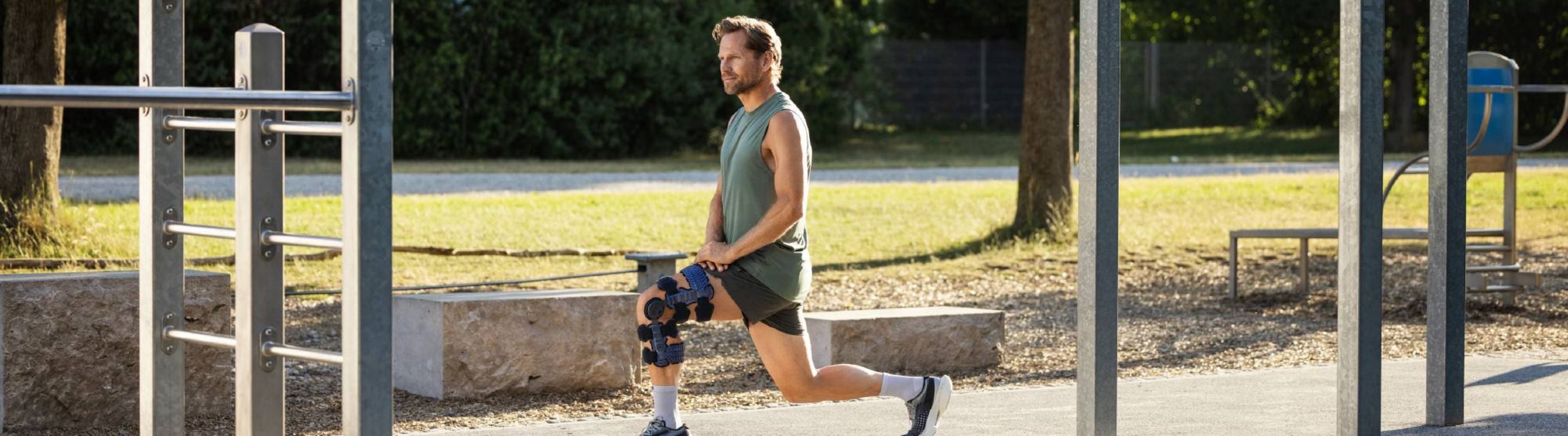
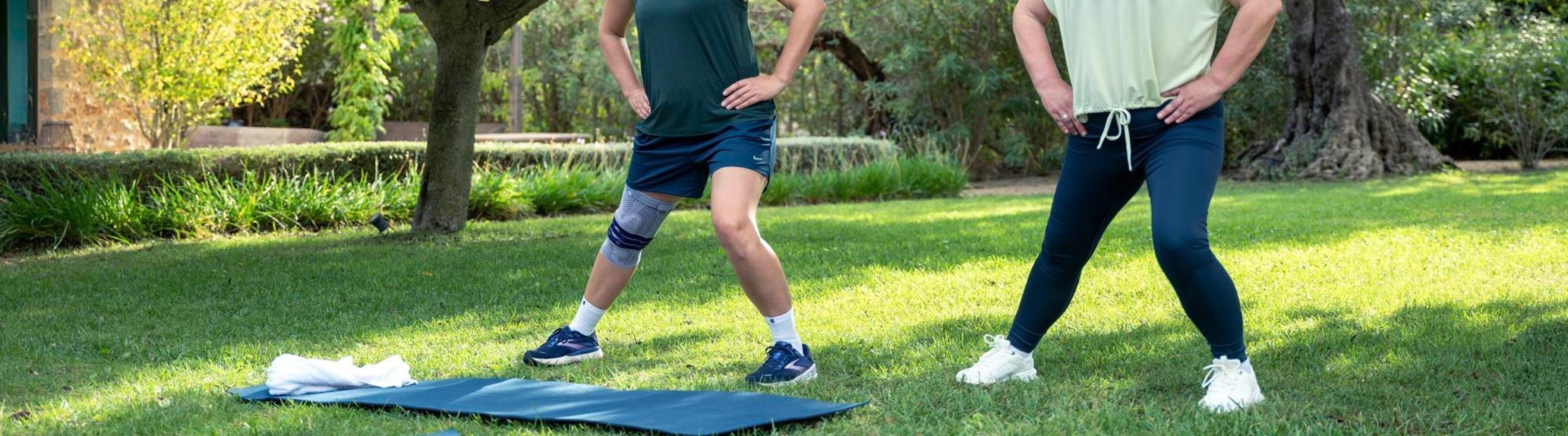
A knee brace or support is a great addition to your plan. They work to reduce pain, swelling, and instability while improving circulation and muscle function. We have a huge range of supports to choose from, from the GenuTrain Knee Support for mild conditions like patellar tendonitis to the GenuTrain S for serious meniscus damage.
These supports both incorporate medical-grade compression to support circulatory and muscle activity and patella pads to relieve pain. The GenuTrain S also has robust anatomical stays for additional support.